

How To Install Commercial Chain Link Fence
Chain Link Argue Installation Manual
Shop: Chain Link Fence | Fence Tools
Read More: How to Install Chain Link Fence (PDF) | Chain Link Installation Tutorial (PDF) | Chain Link Fence System Overview
Jump to Preferred Department:
Before You Begin:
Pace i - Obtain necessary zoning and edifice permits. There may be local zoning or human action restrictions pertaining to height and type of contend and/ or gate. Cheque out belongings line setback requirements. Find surveyors pins if the fence is to be located near property lines or have the lot surveyed.
Step 2 - Measure fence footage and locate gate placement.
Step three - Call 811 earlier you dig. Notify your local or state utilities protection service to locate potential buried utilities. There is usually no charge to locate utilities, however a hefty charge could exisit for repairing buried utility lines, not to mention a potential injury to yourself.
Pace four - Purchase your Chain Link Fence from HooverFence.com.
Tools Needed For Installation:
Post Setting/Layout Tools:
Chain Link Stretching Tools:
Unwrapping and Inspecting Fence Shipment:
Prepare for your HooverFence.com contend delivery. Chain link fence orders can arrive on pocket-sized and large trucks, covered trailers and flatbed fence trucks. Forklifts are normally not required, withal be prepared to hand unload fence tubing, rolls of chain link, bags and boxes of chain link fittings.
The beginning affair we recommend is that you advisedly unwrap and inspect your shipment to verify that you have all of your materials. Make sure to go over and read all of the instructions at this time. While the installation of the argue is relatively piece of cake, this online instruction guide should eliminate any guesswork. If you accept any questions or issues installing the fence, delight give us a call.
Read More: Shipping Policy.
Plant Fence Lines:
Yous volition establish the future fence line past using the stakes and string to stake out the expanse to be enclosed.
Stride 1 - Drive stakes a foot or two away from where you lot want corner and terminate posts to exist located; this volition allow you lot to drill/ dig holes without obstructions. Information technology may also allow you to 'drop' the cord while excavating for fence post holes. Be conscientious not to bump or movement stakes. If you remove the string to excavate holes, have intendance to restretch the string line back the way it was prior to removing.
Step ii - Stretch masonry guide string tight betwixt these stakes. This cord will stand for the location of the debate and serve equally a guide string as y'all ready posts. Posts will be ready in physical or driven one/eight-1/4" from cord line.
Step iii - Intermediate stakes may be required for longer stretches of fence. Exist sure to pull cord taut equally cord which sags or moves with the air current will cause posts to be set up incorrectly. Proceed in mind, the fence tin only be as straight as the guide string.
Step 4 - Locate gate posts commencement and mark their location with upside downwardly post hole mark paint. Side by side measure each stretch of fence. Chain link debate posts are typically spaced a maximum of ten feet apart. For artful reasons, space posts evenly, but do NOT exceed ten feet between posts. If you program on installing privacy slats or another type of material that will increase wind load, consider using 8' or vi' post spacing. Likewise consider upgrading the framework, i.e. posts and rail to a larger diameter and thicker wall thickness. Heavier concatenation link framework such equally HF20 and/ or HF40 are excellent choices for utilise with chain link fences with aluminum diagonal or PVC privacy slats or privacy screening.

Mark Paint

Mail Location
Creating Square Corners Using the 3-4-5 Method:
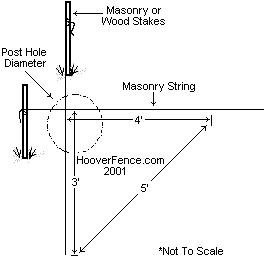
Pace i - Stretch string downward the 2 adjacent sides every bit shown in drawing.
Step 2 - Measure and make mark 3' downward on one line.
Stride three - Measure and brand marker 4' downwards on other line.
Step 4 - Mensurate diagonally between the two marks and adjust lines to achieve five'.
Note: For greater accuracy, use measurements in multiples of iii-4-5, such as half dozen-eight-x, etc.
Setting Posts:
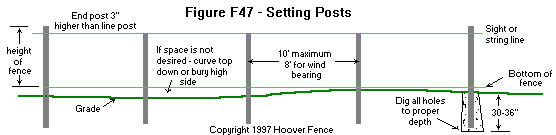
Typical Mail service Layout
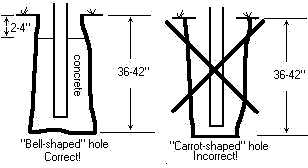
Correct Mail Hole Shape
Footstep one - Depending on the geographical location, fence height, and fencing materials used, post hole size may vary. In general for residential chain link fences, dig holes 6" in diameter past xxx" deep (or below frost line in your expanse). Some other dominion of thumb is to dig the holes three times the diameter of the mail service, i.e. a 2" diameter post would crave a 6" bore hole, and put ane third of the peak of fence that's above ground - in the ground. Typically gate post holes are dug larger in bore and deeper to withstand the additional stress of a moving gate. The guide string may be removed temporarily prior to excavating to prevent cutting it. Be sure to supplant it every bit it was originally stretched.
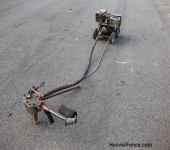
Chain link fence posts holes can be dug by hand with post hole diggers and murphy bars, small gas powered augers, or skid steers with hydraulic augers. Size your auger chip accordingly to the height and grade of fence materials to be installed.
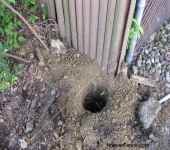
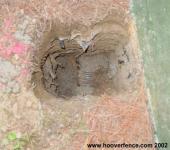
Holes side by side to buildings often must be dug by hand. Take caution as drain pipes and other utilities tin exist located near foundations.
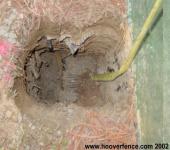
Some obstructions such as the one above can be difficult to bargain with. A post may exist bent in this case to miss the pipe. Mensurate the depth of the curve showtime.
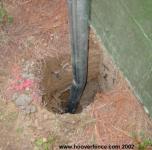
Discover how the postal service remains tight to the business firm, however is notwithstanding dug to depth with a sufficient concrete footer.
Step two - Restretch guide string and check holes for accuracy visually and/or past placing a mail service in the hole and plumbing in all directions. If the hole needs 'shaved' or moved, do it now. If holes are shallow because you striking an object you tin't remove, 'bell' the pigsty at the bottom. To 'bell' a hole, apply a post hole digger and/ or irish potato bar to make the lesser of the pigsty larger than the top. This further anchors the physical footer which will support your argue. 'Belling' will compensate for holes equally shallow as eighteen" deep. If necessary, movement the pigsty slightly to miss whatsoever obstructions. This will change your postal service spacing. However, there is no impairment in the case of line posts. If y'all must motility it more than than a couple of feet, consider installing an actress post midway in the enlarged space. Other means of dealing with obstructions include bending posts below ground and welding plates on to posts to secure to big rocks.
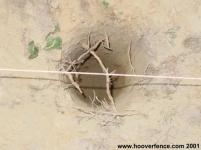
Check hole location prior to filling with physical mix. The hole should not be centered perfectly nether string line; it should exist commencement slightly and so that the mail will be centered in the concrete footer. If necessary put mail in empty hole and bank check plumb with a level. The post should exist plumb to the string with approx. 1/eight-one/4" clearance. If not, debate post hole will need 'shaved'.
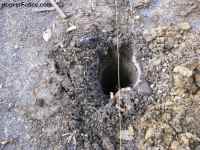
One time fence posts holes accept been dug and cleaned out, check that each and every hole is in the correct spot. If yous cannot tell visibly, place post in pigsty and plumb mail service. Post needs to sit down plumb and be placed 1/viii"-ane/4" off the string line.
Fence Tip: Be sure to dig fence post holes to the proper depth and diameter for your region. Northern regions have frost depths deeper than the southern part of the country. thirty-36" deep concrete footers suffice for nigh argue installations.
Step 3 - Mix concrete with water using pre-mixed handbag. Become like shooting fish in a barrel on the water. Mix should look similar thick grey mud, not like Mom's watered-downwards chili. If it doesn't pile upward on the shovel, it's too thin; add more mix to dry information technology up. If y'all are mixing from scratch using aggregate like gravel, limestone or bounding main shells, concrete sand and Portland cement, mix 3 to 4 parts (shovels) of aggregate to 2 parts sand and 1 part cement.
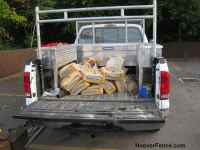
Smaller fence projects are often fix using a premixed bagged concrete. Frequently sold at practice-it-yourself stores, xl, 60, and 80 pound bags are usually readily available for your fence project. Effigy your fence postal service concrete requirements by using HooverFence.com's physical calculator.

Premixed numberless of concrete may be mixed past hand in a wheelbarrow with a shovel, or with a gas powered, or electric powered cement mixer. Mix concrete to a 'thick milk shake' like consistency. Do not mix besides wet, or the soup-similar texture will crusade posts to sink, or the concrete may not gear up at all.

For small concatenation link contend jobs where the task can be set and stretched in the same solar day, using a pocket-size amount of Quik Rok, or other brand of fast setting hydraulic cement with regular premix cement can relieve time and an extra trip to the jobsite.
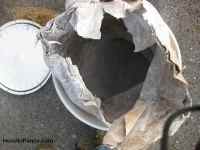
Quik Rok, fast setting hydraulic cement is available in 5 gallon pails and is a powder like fabric that can be used alone for minor holes (cadre drilling in cement). You lot tin besides mix about a shovel full of this baking flour similar cloth in with a wheelbarrow total of regular cement.
Contend Tip: Some fence spec jobs require physical footers to be poured to the superlative, capped and trowelled. Apply a pointing trowel for better appearance.
Step 4 - Marker post grade marker. Stop, corner and gate posts should be marked at the superlative of the debate plus 1 inch; 49" for a four' argue, 61" for a 5' debate, etc. Mark intermediate or line posts at pinnacle of the fence minus 3 inches; 45" for 4' argue, 57" for 5' fence, etc. When you add your line mail cap and top rail, the summit will be accurate. Grade marks correspond the bottom of the debate and are essential in setting posts to the right depth. If you coffin the post hiding the grade mark by 1", you volition need to trench to coffin the fence here. If your course marker is above basis past 3", your fence will be off the ground by three inches and yous better program to cutting it off later or fill under the fence if a tight fit is necessary.
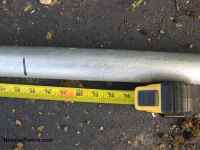
For chain link fences, line posts (intermediate posts) should be marked with a grade mark at 3" less than the height of fence being installed. Here a vi' high debate is existence installed. Line posts are marked at 5'-9".
Fence Tip: Vinyl coated chain link fabric is more elastic than galvanized mesh and can 'shrink' slightly when stretched. Subtract an boosted 1/2" if y'all're setting posts for a fence with vinyl coated fabric.
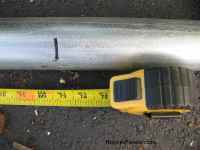
For chain link fences, terminal posts, i.due east. terminate posts, corner posts, and gate posts, are marked at 1" more the meridian of fence being installed. For a half-dozen' loftier chain link fence, mark posts at 6'-1".
Fence Tip: Place a spare slice of tubing, or postal service that has not nevertheless been assault the summit of gate posts afterwards setting and level these posts to 1 some other. Gates are usually perfectly square.
Step 5 - Fill up holes with wet cement. Exercise not fill up too many and take a chance having the concrete cure before you tin can 'stick' your posts. Exercise not fill up holes to the the pinnacle with concrete, leave the concrete downward 3-4". Filling the pigsty completely with cement is a common mistake. If this is done, water volition collect under this 'lip' of concrete. When information technology freezes, the basis will literally squeeze the concrete footer and 'heave' the mail service up, much like squeezing a tube of toothpaste.
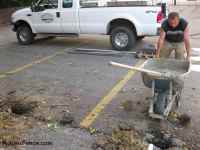
In one case fence post holes have been dug and cleaned out (be sure to make clean out post holes of loose clay and droppings), shovel cement into holes until they are near full. Leave cement down from the ground surface (form) approx. 3". Holes should besides exist larger in diameter at the bottom than at meridian, 'bong-shaped'. Holes shaped like a carrot tin can boost prematurely.
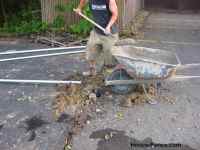
Fence post holes can be filled practically as fast equally the cement batches can exist mixed and poured. Ofttimes another person can follow the person filling the holes and 'stick' the fence posts. 'Sticking' fence posts merely means putting the posts in a hole that has already been filled with cement, plumb and tight to the string line.
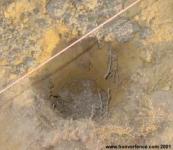
Fill post holes with concrete mix. Practise non fill holes completely. This may cause posts to heave prematurely.
Stride 6 - Stick Posts. Nigh chain link posts can exist installed by really pouring the cement in the pigsty first and so 'sticking' the mail in the moisture cement. Merely push button the post into the cement mix in the center of the hole. Set up terminal posts as tight to the cord equally possible without touching the string. Set line posts approx. 1/viii"-1/iv" off string. This will account for the differences in fence post diameters. Another style of setting posts is for one person to hold the mail plumb to the string line while another shovels concrete mix around the post. The first method explained is actually easier, a more efficient manner of setting contend posts, and assures there is physical around the postal service, under information technology, too as in it.
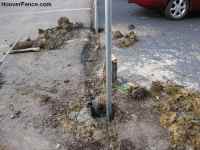
Chain link argue posts should be 'stuck' down to their corresponding course marks and plumbed with guide string. Backfill with loose dirt and step gently on clay surrounding posts to help agree them too height. If posts sink on you, concrete is besides wet, or holes have filled with h2o.
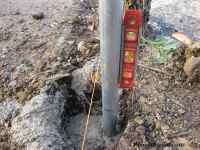
You tin can and should put your posts in their holes and cheque them to the string line with a level if you're not certain mail service holes have been dug in the right spot. It tin can be very frustrating if holes have not been checked for accuracy, then filled with cement. Yous'll discover yourself trying to stick posts into the dirt environment the dug pigsty, but cached in cement. If this happens, pull postal service, redig hole, and attempt to catch up with your crew!
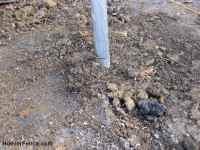
On sloped terrain, it is sometimes necessary to set posts intentionally loftier, with course marks exposed. The chain link height is really taller when measuring diagonally. If in doubt, measure square with grade to assistance estimate your finished tiptop of the fabric. Chain link is remarkably versatile and tin can be installed on any terrain.
Fence Tip: When in doubt, exit mail high and cut off later on. This is much easier than trying to extend the height of a chain link debate mail!
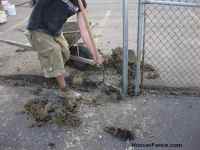
After concatenation link fence posts have been 'stuck', cheque cement level is correct. You should put more cement in if concrete levels are too low.
Debate Tip: Avoid pushing away your guide cord to fill holes with cement if some other is using it to 'stick' posts!
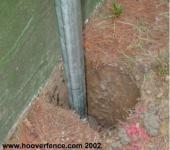
Set posts to the depth of the grade mark first. Be sure to set fence posts tight to any buildings if animal containment is important.
Step 7 - After setting each mail to grade, backfill with dirt and step on the backfill to hold the mail to meridian. Echo for all posts in this length of fence.
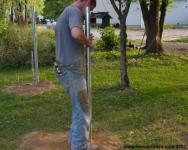
Afterwards 'sticking' post in hole with concrete mix, backfill with loose dirt. Plumb post while stepping on dirt around post. This volition assistance hold the post plumb in the pigsty.
Step eight - Sight posts. To 'sight' in posts, stand up at cease of length of fence and look beyond the tops of the posts. Adjust heights of posts as necessary to account for gradual slopes and changes in grade. The goal is to have smooth transitions between posts and to avoid abrupt changes. This is easiest for two people to accomplish: one persons sights posts while the other adjusts and checks for post plumb. Be sure to check plumb on each post after adjusting and sentinel the grade marker as noted above.
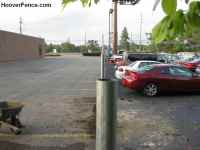
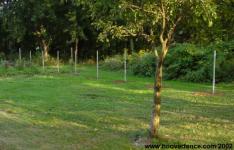
Once posts have been set to grade, sight across the tops of the set posts and heighten or lower them slightly to smooth out the peak of the fence. Continue in mind, if you bury your class mark slightly on ane or more posts, plan to trench this same amount for the chain link fabric. The grade marks correspond the lesser of the chain link fence. If your grade mark is iv" off the basis, and then volition exist your fence and you may be filling underneath.
Note: Although virtually fences are only installed to grade, or menstruum with the contour of the land, some applications would exist improve set up perfectly level, i.east. tennis court enclosures, basketball court enclosures, baseball and softball backstops, sideline fences, and homerun fences. If excavating, grading, or asphalt/ concrete is to be poured afterward, or is already in place, the debate may need to be installed perfectly level. If this is the example, sighting with grade marks, using a cord line with a level, or a transom will assistance immensely.
Footstep 9 - Install gate posts with the exact opening size every bit recommended by gate supplier or manufacturer. The opening size is the distance between the two gate posts, inside to within. If possible make the tops of gate posts level to each other past placing a mail beyond the tops of the posts and checking with a level. If the ground slopes off sharply nether the gate, set the gate posts to course. It won't look proper to make them level.
Step 10 - Let physical cure for at least 24 hours prior to standing work.
Installing Post Fittings:
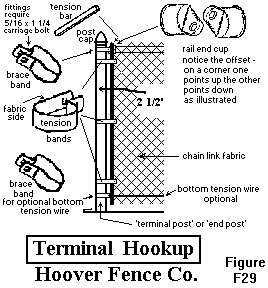
Typical Terminal Post Fitting Diagram
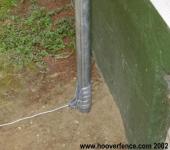
View of lesser brace band for bottom wire, and four tension bands for a 5' high chain link debate. View is from the inside of contend. Notice tension bands are offset so that the flat side is facing out.
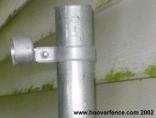
End post with brace band bolted with a rail end cup. All basics confront towards the inside of the chain link fence enclosure.
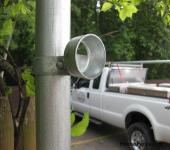
Philharmonic runway end cups (with holes in them for truss rods) may be used for top rail, mid rails, and bottom rail to connect fence rails to terminal posts.
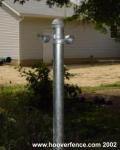
Proper installation of rail stop cups and brace bands for a concatenation link fence corner post. Notice ane points upward, the other down. This allows acme rail to remain even at such a junction.
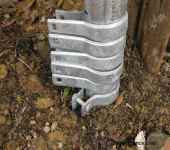
Ane chain link caryatid band with nut and bolt and 5 tension bands are used for a 6' high chain link argue.
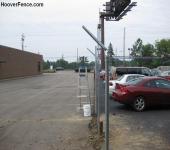
Here spinous wire artillery are used every bit loop caps for a 6' loftier plus 1' of barbed wire chain link debate.
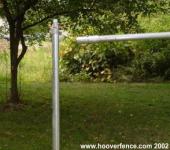
Loop caps simply slide on top of posts. Top rail slides through horizontally.
Pace 1 - Place tension bands on stop and corner posts.
Footstep 2 - Quantity of tension bands per claw-up = height of contend minus 1; minimum of three. For example, a 4' high concatenation link argue requires 3 tension bands per claw-up.
Step 3 - A hook-upwards is each connection of concatenation link to an cease or corner post. End posts accept one hook-up; corner posts have two hook-ups.
Stride 4 - Identify one brace ring on first to use if bottom tension wire will be installed. This fitting requires 1 five/sixteen" x 1-one/4" standard fence commodities and nut. Install nut and bolt loosely.
Step 5 - Next, install tension bands. The tension bands are offset. The commencement (flat side) faces 'out', the same side as the chain link fabric volition exist installed. This is unremarkably the exterior of the enclosed expanse. Do not install basics and bolts on these.
Footstep 6 - Identify one caryatid band per claw-upwards over the tension bands . This fitting requires one runway end cup, ane commodities and nut. This band and cup will be used for the top rails. Tighten with a ratchet and socket.
Step 7 - The runway end loving cup is offset too. This start can be upwardly or down on an finish post. Regardless of if you choose to position the loving cup up or downwardly, be consequent. On a corner, since two sets of caryatid bands and rail stop cups must share the aforementioned space, the lesser rail stop cup is to be beginning up and the lesser rail end cup is to be first downwardly. This enables the two cups to be level to each other, and so your height rail can be inserted into the cups and be level to each other.
Step 8 - Typically all basics are kept on the inside of the contend; this prevents someone on the exterior from removing the nuts easily. For high security applications, the threads on the bolt may exist 'peened' to forbid piece of cake removal. This can be done by using a hammer and chisel and distorting the threads on the bolt so the nut tin can not be removed.
Step 9 - Place post caps on posts. The cease and corner mail service caps are simple. In that location is but ane way to install them. The loop caps, as they are called, are offset, if you look at them advisedly. The offset side faces the outside of the enclosure; the same side as the chain link will be installed. Chain link loops caps are bachelor in aluminum, or pressed steel with a galvanized stop. If spinous wire is to exist installed, substitute barbarms in lieu of standard chain link fence loop caps. Concatenation link 3-Wire barbarms are bachelor in as 45 caste barbarm, straight vertical barbarm, and an adjustable barbarm. We also carry a 6-wire barbarm.
Debate Tip: You may 'pre-squeeze' bands afterward they have been slid on to posts. This is done by essentially pinching brace bands and tension bands with a pair of contend pliers. Make sure y'all continue commodities holes lined up equally y'all squeeze the bands close. Later, when you are connecting the coil of chain link to the terminal posts, you will exist thankful bands accept been pre-squeezed every bit they volition at present allow yous to fit your 5/16" ten 1-1/four" nut and bolt through and thread the fence nut much easier.
Installing Top/Bottom Rail:
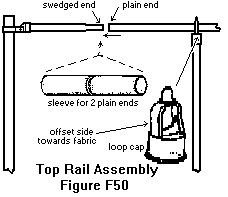
Typical Top Track Associates Diagram
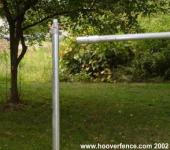
Loop caps simply slide on superlative of posts. Top rail slides through horizontally.
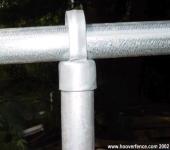
Offset of loop cap faces 'out'. This helps keep the framework flush to the textile side of the concatenation link fence.
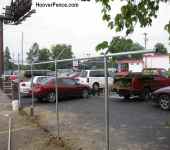
Tiptop rail sits on top of line posts and runs 'to' concluding posts.
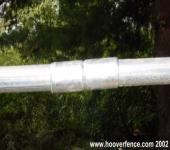
i-iii/viii" and 1-5/viii", common sizes for top rail, are available swedged or manifestly terminate. Evidently stop top runway requires sleeves as shown above.
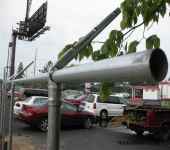
Chain link fence height rail with manifestly ends volition require top runway sleeves. HF40 heavy industrial top runway is only bachelor with obviously ends.
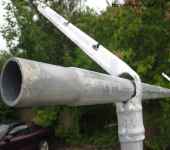
HF20 top track and lighter is available with a swedged end, a sleeve volition not be required.
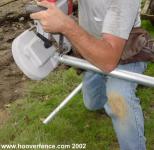
A hacksaw, chop saw, sawzall, pipe cutter, or portable band saw are used to cut meridian rail.
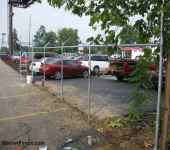
Chain link fence with top runway finished. In one case framed, chain link textile may be stretched.
Footstep 1 - Slide top rail through a couple loop caps and butt end firmly into rails stop cup. Adjust meridian of runway end cup if necessary. Tighten rail end cup firmly.
Footstep ii - Some top rail has a 'swedged' stop, which tapers downward so it will fit into another piece of rail. Fit the non-swedged end into the rails end cup at the end or corner post.
Step 3 - Add sections of rails, sliding each non-swedged end into a swedged end. Be certain to push rails toward your beginning point to 'seat' them all the way into each other. Push firmly. If the superlative track has no swedged end and so y'all need a 'sleeve' that acts every bit a coupling.
Step 4 - Add boosted acme rail until you reach the next terminal post, i.due east. end, corner, gate post.
Step 5 - Cutting excess rail off with hack saw or pipe cutter. Mark the cut-off point carefully and then the rail will fit snugly into the rails end cup. Whatsoever slack in your entire length of rail will permit the chain link, when stretched tight, to pull the terminate posts in towards each other. Tip: Each piece of rail should be supported by 2 posts. Do not cut rail and so that a seam will be in-betwixt the last line post and terminal postal service. This point will be weak and tend to sag.
Stride 6 - Install peak rail in all stretches of fence. At this point, visually check the height of line posts once pinnacle rail is installed. If a post is besides high, remove rail and trim as necessary.
Fence Tip: If a mail service is i/iv" too curt you may also cut a sliver of piping, the same diameter size as the line post and sideslip it under the loop cap.
Note: Industrial chore sites occasionally substitute a superlative tension wire in lieu of top rail to cutting down on toll. If this is the case, you will demand to brace and truss the final posts. Read More than: How to Brace and Truss Concatenation Link Fence.
Installing Tension Wire:
Effigy i
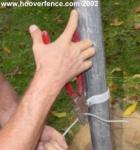
Figure ii
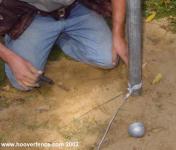
Figure 3
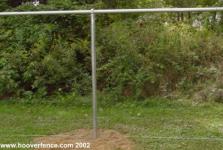
Figure 4
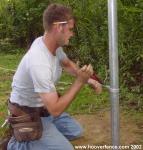
Tension wire may be installed at the top and/or bottom of a chain link fence. Top tension wire helps cut downwardly on cost when used in lieu of tiptop track. Bottom wire helps deter animals from digging and pushing the bottom of the material out. Information technology is frequently used with vinyl coated chain link as this tends to be more rubberband in nature. Both types of wire are fastened to the concatenation link, once stretched, with hog rings. Information technology is easiest to install when one person holds the gyre of wire upright while the other 'walks' the loose end to the other end of the fence. The next step is to claw upwardly the loose end to the last post using a brace band and nut and commodities. The loose end is looped through the commodities and wrapped around the wire itself (Fig. one & ii) The tension wire loop is 'sandwiched' in the brace ring. Bottom tension wire is installed on the same side of the posts as the concatenation link fabric (Fig. iv.) Once chain link is stretched, the bottom tension wire will exist 'sandwiched' between line/ intermediate posts and the chain link fabric (Fig. 10). If used equally a height wire, thread tension wire through loop caps and connect at each terminal post.
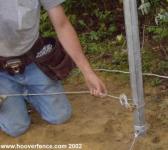
Figure 5
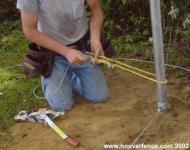
Figure six
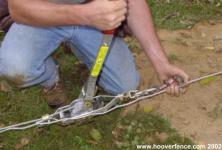
Figure 7
Effigy 8
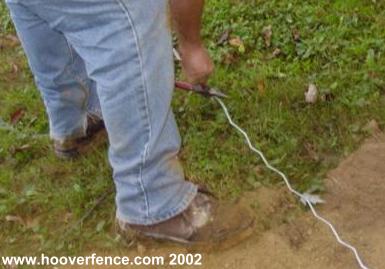
Tension wire is most ordinarily stretched using a come-a-long and wire grip. Do not wrap the cablevision of the come up-a-long effectually the post (Fig. 5). This action washed repetitively will crusade the cable to fray and exist destroyed. Instead a 'sling' may be fabricated of rope or cable to wrap around the stretch post (Fig. vi). Release and pull out six-ten' feet of cable from the come-along. The length of cable to pull out will depend on the length of stretch of tension wire. Hook a cable puller to the ratchet end of the come up-a-long. Secure tension wire to cable puller (Fig. 7). Crank the handle of the come-a-long until the tension wire is tight (Fig. 7 & 9). Do not tighten too much or post impairment or physical injury may occur.
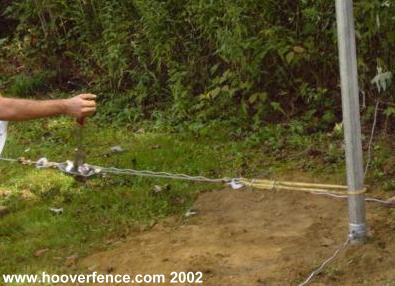
Figure nine
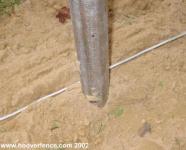
Figure 10
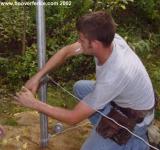
Figure 11
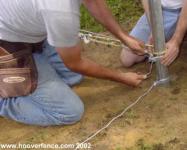
Figure 12
With the come-a-long cranked tight, curve the tension wire where information technology would loop into the nut and bolt. Adjacent, cut vi-8" past this curve with bolt cutters. Be careful as both ends of the wire will 'whip' from the tension and can be dangerous. Fish the looped end of wire through the nut and commodities and wrap as before. Release come-a-long; echo process for other runs of fence. Note: Short lengths, approx. 12' and less, are difficult to do using a come-a-long. These are often simply done by hand. The tension wire naturally has crimps in it. With the use of pliers in their open up position, these crimps tin can be crimped farther causing the wire to tighten (Fig. eight). Be sure to crimp throughout the length for uniform appearance.
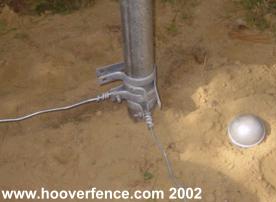
Figure 13
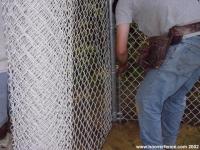
Figure 14
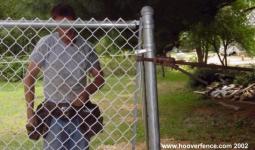
Figure 15
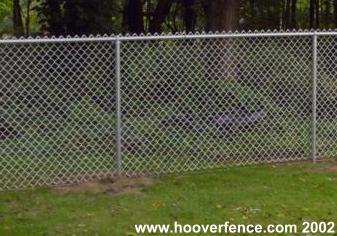
Effigy 16
One time tension wire is installed, the chain link fabric may be stretched. Chain link is installed to terminal posts using tension bars, tension bands, and nuts and bolts. Often one end is installed with the roll upright for ease (Fig. 14). The roll may and then be laid downwards apartment of the ground and rolled to other cease. Additional rolls may be added hands and the weaving is easily washed on the flat ground. Chain link is stretched with a come-a-long and spreader bar for longer stretches (20' or more). A pul-jak is used for shorter stretches (20' or less) (Fig 15). Equally tension bands are installed an equal distance autonomously, normally the lesser brace band belongings the tension wire may be adjusted so that the tension wire is centered on the bottom diamond of the material. The top track, line posts are tied last. Hog rings are installed to secure the tension wire to the chain link material using hog ring pliers.
Stretching Chain Link Fabric:
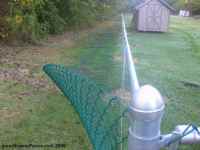
Hook-upwardly chain link fence to i last post and roll it out towards other stop.
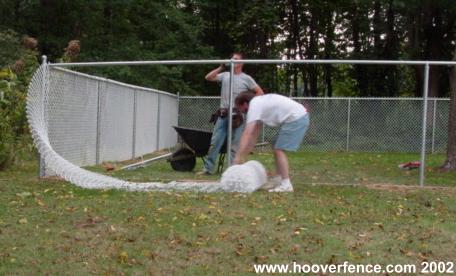
It is best to lay chain link rolls down flat for longer stretches.
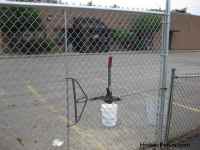
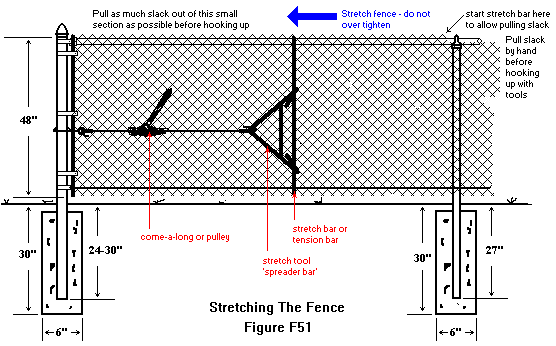
Stretch chain link argue using a stretch bar, come up-a-long, and a tension bar.
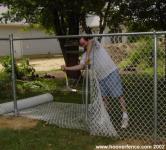
A come-a-long is required for longer stretches of debate.
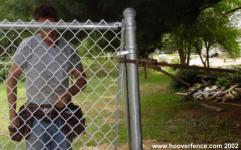
A pul-jak is the platonic tool for brusk stretches of fence.

Remove a weave to 'cut' the fabric to the correct length.
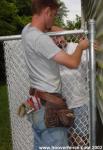
Hook up tension bands using v/16" x i-1/four" nuts and bolts. Adjust height before tightening.

View of debate from inside: Notice flat side of tension ring faces out, nut is on inside.
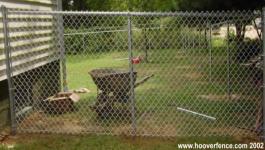
Tentatively adjust height before tightening nuts and bolts.
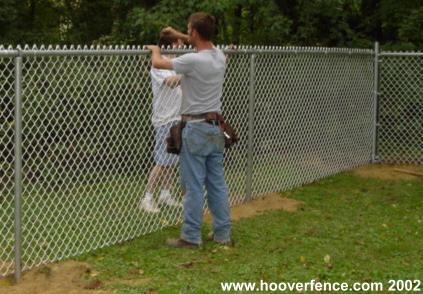
Be sure to center top concatenation link diamond on track prior to tying.
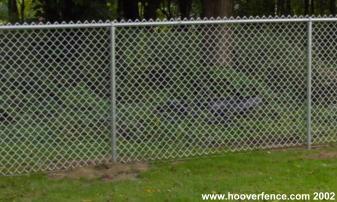
The finished chain link fence.
Pace 1 - Starting at one end of a line of fence, roll chain link out on the exterior of the enclosed area or the side you previously have called.
Pace two - Curl out some other ringlet, if more is needed to reach the next cease post. Chain link is stretched in 1 continuous length of woven chain link from end mail to end mail service.
Step three - 'Weave' chain link rolls together. This can be a little tricky, if never done before, and requires some explanation.
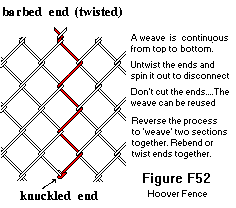
Each weave is continuous from the superlative to the lesser along the vertical or pinnacle of the whorl. If you follow the strand, starting at the top, you will run into that it zig-zags back and forth to the bottom. It starts and ends with either a 'knuckled' or a 'twisted' end.
To remove a weave, unbend the terminate of the weave 'knuckle' straight. Unbend the adjacent weave that is knuckled to information technology. If it has a twisted terminate, simply untwist the two weaves until they can be separated.
Follow the weave to the other end as information technology zig-zags back and forth and untwist or unknuckle the opposite end. Be certain you follow carefully, so y'all undo the proper weave.
At the acme of the fence or the bottom, spin the weave in a counter-clockwise direction, as if to unscrew information technology from the roll. Well-nigh newly manufactured chain link spins out counter-clockwise, whereas some chain link manufactured years ago spins out clockwise. Go along spinning and you lot will see the other cease unweaving from information technology's side by side weaves. If you are having difficulty, you may have disconnected the wrong weaves at the opposite end. Also check that you have bent the far end direct or it will snag every bit you effort to spin it. Another problem that may occur is the chain link is stretched to tight; give yourself some slack.
The process for weaving two rolls together is just the opposite except it tin be tricky getting started. It is easiest to weave two rolls together when they lay flat on the basis, withal rolls may exist wove together in the upright position too.
To first weaving: Chain link forms squares or 'diamonds' every bit they are ofttimes chosen. You must match two sections or rolls together earlier you start weaving in such a manner that one scroll has a total diamond and the other roll has a half diamond. This friction match will be at the height and bottom of the rolls. When you add a weave, yous will finish up with a full diamond and ii ends to knuckle or twist together.
Many rolls of chain link will have a loose wire in the whorl. Use this to slice two rolls together or remove ane wire from one of the rolls to splice with. Spin the single weave into the outset full diamond. Spin it through the adjacent full diamond of the other roll. Go along spinning and brand certain that the weave end goes through each full diamond on each roll in each revolution.
If yous have trouble, information technology could exist from one or more of the following reasons: Your concatenation link is also tight; give some slack. You missed a diamond somewhere; unweave and attempt again. Lastly. you may have mismatched rolls that came from different manufacturers or the rolls have unlike mesh sizes; count the number of full diamonds in each roll, they should match in number and size.
After you take successfully woven the two rolls together, twist or re-knuckle the ends together. If you accept no counter weave to fasten to, you started with either ii half diamonds on each roll or two full diamonds on each scroll. Take information technology apart and endeavor once again. Sometimes you have to flip the one roll over (most have a half diamond at one cease and a full diamond at the other) or remove a weave from one roll to create a starting half or full diamond.
Footstep 4 - After rolling out the concatenation link and weaving the rolls together, 'hookup' i stop. Space the tension bands evenly every bit illustrated above (Fig. F51). Make sure the nuts are on the inside of the fence so they tin non exist removed from outside the enclosure.
If you accept a sharp incline approaching a terminal postal service, the fabric must be cut on the end. This is called a bias cut. Read More: How to Bias Cut Chain Link.
Step 5 - Pull the chain link tight by hand to the other end. You may stand up the concatenation link and lean it against the posts or leave information technology on the basis and lean it up equally you lot stretch the fabric later. By and large the later is easier and meliorate on long stretches.
Step 6 - Hook upwardly stretch tools as illustrated on inside of fence (Fig. F51). Slide a tension bar ten-12' away vertical in chain link fabric; hook stretch bar to information technology on within.
Step 7 - Make sure the come-a-long hook faces away from the fabric or information technology may get caught in the diamonds.
Step 8 - Tighten the come up-a-long slowly. Check that the fabric is not getting caught on posts, tree roots, or other obstacles.
Pace 9 - 'Dress' the fabric as you lot tighten information technology. 'Dressing' involves straightening the cloth diamonds and so they run true. This is vital for heavier gauge fabrics. Some spots will exist higher than others every bit you sight downwardly the summit. Lift the fabric in the low spots. This must be done before the fabric gets too tight. One time information technology is tight, little tin can be done to straighten the cloth. Some fabric dresses easily, some does not. If the textile does not wearing apparel up properly, yous can ever loosen the come up-a-long and try once again. Cheque top and lesser diamonds for any wires that may bind out of proper shape. Lift and shake fabric to clinch an even tension throughout coil(s).
Step x - The textile is stretched sufficiently when yous can't squeeze the diamonds together with one paw. Exercise not over stretch or post harm will occur. The top of the fence should 'snap' dorsum to the posts when pulled out a little.
Footstep xi - Paw stretch the small section of chain link left between the come-a-long and last post by hand. Remove a weave to 'cut' the cloth to proper length. Slide the tension bar into the mesh and make your terminal hookup. Once all bolts are in place, remove the stretching tools.
Tying Off The Debate:
Stride ane - Install tie wires onto top rail offset to constitute the height of the fence. The top diamond of chain link should be centered on the top rail.
Step two - Space tie wires evenly and no more than than ii' apart.
Step 3 - Tie line posts last. Use the same number of tie wires per line postal service as tension bands per concluding. This quantity is a minimum of 1 per human foot.

Installing Chain Link Gates:
There are many different types of hinges and latches on the market today for employ with chain link gates. Almost are self-explanatory and do not include a set of installation instructions. Installation instructions commonly accompany the more complicated hinges and latches.
Single Swing Gates:
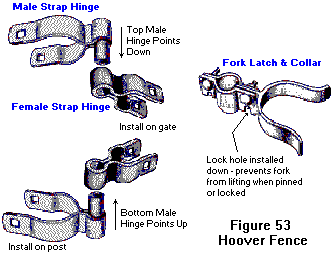
Bones Swing Gate Hardware
Step one - Install female hinges on gates using nuts and bolts. Once more, basics should be installed on the inside of the enclosure. Infinite them the maximum distance autonomously as possible.
Step 2 - Agree gate in opening and mark the location of male person hinges. Point the male swivel on the bottom upwardly and the i on top down.
Step 3 - Install bottom and summit male hinge with bolts. Tighten lesser hinge snug, but leave superlative hinge loose.
Step iv - Identify gate on bottom hinge and lower top male hinge into female person hinge.
Footstep 5 - If the space under the gate is acceptable. Tighten top male hinge snug.
Step six - Test swing the gate to run across if it will miss the ground. Adjust as needed.
Step 7 - Tighten all swivel bolts. Exercise not over tighten.
Footstep viii - Install the latch at a convenient height (nuts within).
Double Swing Gates:
In the instance of double swing gates, y'all will desire to install the gate closest to the ground first, unless the ground is perfectly level. Hang 2d gate level to the beginning. Although you may 'pace' the gates for a tight fit to the basis, information technology looks best to install them level to one another.
Follow Steps i-7 from higher up to hang the gates. After that is done, follow the steps below to latch the gates together.
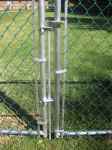
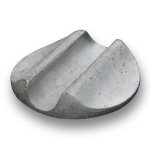
Drop Rod & Heart Stops
Pace 8 - Install the double gate drib rod/latch assembly.
Step 9 - Install middle stop for double swing gate. Close the double gate, making certain the ii leaves are lined up (direct w/ fence line). Mark the ground where the center stop needs to be installed. You may simply use a cut-off slice of pipe as a center stop by driving it into the ground. Go along slowly, checking the gate to make certain you are driving the pipe straight. Yous may besides employ a prefabricated center finish and cement it for a meliorate advent. If the center stop is in a concrete bulldoze, simply drill a pigsty in the concrete larger than the drop rod diameter. Be sure to drill clear through the concrete drive to allow h2o to drain. Always make a much larger pigsty (or pipe size) than the bore of the driblet rod to allow for gate sag, posts shifting, ice and other factors.
Optional Step - Install Gate Holdbacks if desired. Open gate(southward) to the desired 'open' position. Cement or drive a 2" O.D. mail service a couple inches across this point. Install holdback at correct tiptop using U-bolts provided.
Final Step - Install all postal service caps.
Slide Gates:
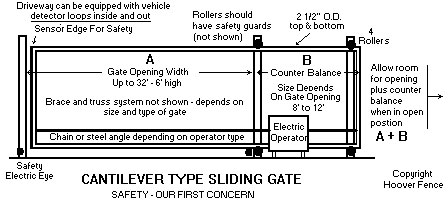
Chain Link Cantilever Gate
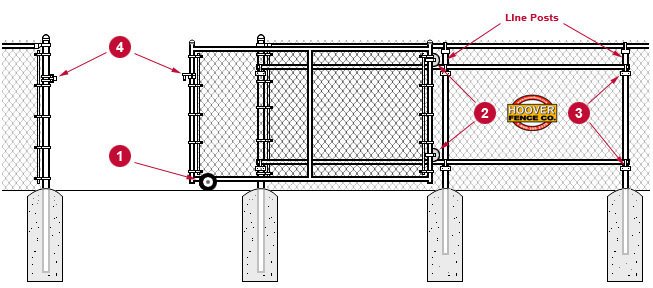
Chain Link Rolling Gate
Read More than: Chain Link Cantilever Gate System Overview | Concatenation Link Cantilever Installation Manual | Concatenation Link Rolling Gate Organisation Overview

Source: https://www.hooverfence.com/chain-link-fence-installation-manual
Posted by: sellspriphy.blogspot.com
0 Response to "How To Install Commercial Chain Link Fence"
Post a Comment